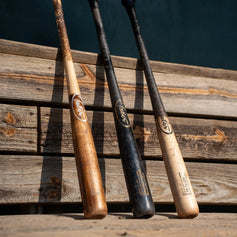


Buying your first wood bat is two decisions wrapped in one: what fits your swing today, and what helps your swing get better tomorrow.
Most hitters approach the choice backwards — they pick a colorway they like, then try to make the spec work around it. The pros do it the other way. They size the bat to the swing, then add the color last.
This guide walks the right order: length, drop weight, turn model.
Step 1: Length — start with your height and weight
Length is the easiest spec to get right because it maps to body size.
| Player height | Recommended length |
|---|---|
| Under 5'4" | 31" |
| 5'4" – 5'8" | 31" – 32" |
| 5'8" – 6'0" | 32" – 33" |
| 6'0" – 6'4" | 33" – 34" |
| Over 6'4" | 34" |
For youth players, use age:
| Age | Length |
|---|---|
| 5–7 | 26"–28" |
| 8–10 | 28"–30" |
| 11–13 | 30"–32" |
| 14+ | 32"–34" |
At-home check: Hold the bat at the knob with arm extended at shoulder height. The right length lets you hold it parallel to the ground for 30 seconds without your shoulder dropping. If between sizes, go shorter — a bat too long slows your swing path.
Step 2: Drop weight — match the math to the league
"Drop" is the difference between length (in inches) and weight (in ounces). A 33" bat at 30 oz is drop -3.
- BBCOR (high school + NCAA): Drop -3 only.
- USSSA (travel ball): Drop varies — typically -8 to -10 for youth.
- USA Bat (Little League): Drop -10 to -12 typical.
- Wood-bat-only leagues: Any drop, but -3 is the pro standard.
- Showcases: Drop -3 wood.
Within league rules, drop is a swing-style choice:
- Lower drop (-2): Heavier swing weight, more pop. Recommended for torpedo bats.
- Standard drop (-3): Pro/college baseline.
- Higher drop (-5+): Lighter, faster swing speed.
Step 3: Turn model — match the bat to your swing
Turn model is the barrel/handle profile. The numbers (271, 110, 243, AP5) come from the original Louisville Slugger catalog from the 1940s.
| Turn | Feel | Best for | Tater equivalent |
|---|---|---|---|
| 271 | Balanced, flared knob | Contact, metal-to-wood transition | X24 Pro |
| 110/I-13 | Balanced, thin handle | Contact and gap hitters | X4 Pro |
| 243 | End-loaded, extra-large barrel | Power hitters | 243 Pro |
| AP5 | Slight end load, elongated | Power hitters | XL5 Pro |
| 141 | Long barrel, slow taper | Gap-to-power hitters | X6 Pro |
| Torpedo | Sweet-spot-loaded | Advanced hitters wanting forgiveness + pop | Tater Torpedo |
If you don't have strong opinions, the 271 is the safest first wood bat.
The four most common mistakes
- Going longer than your body can swing.
- Choosing end-loaded when you're still building bat speed.
- Picking the colorway first.
- Ignoring the drop rule for your league.
What to do next
- Know your specs? Head to the Custom Wood Bat Builder.
- Need it now? Browse in-stock bats.
- Not sure? Take the Bat Finder quiz.
FAQ
What size wood bat should I use?
The general rule: 31" for hitters under 5'4", 32" for 5'4"-5'8", 32"-33" for 5'8"-6'0", 33"-34" for 6'0"+. Youth follows age sizing. Between two sizes? Go shorter.
What does the drop number mean?
The drop number is the difference between bat length (inches) and weight (ounces). A 33" bat at 30 oz is drop -3. Lower drops are heavier and slower with more pop. Higher drops are lighter and faster. BBCOR requires drop -3.
What's the most popular first wood bat?
The 271 turn (Tater X24 Pro). It's balanced, has a medium barrel, and a forgiving feel for hitters transitioning from metal.
Tater Baseball builds custom wood bats in Connecticut — family-owned since 2015. Start your build at the Custom Wood Bat Builder.
Best seller


Best seller


30
31
32
+3
Best seller